




Why Making Friends as an Adult Feels Like Starting Over
Making friends as an adult sounds like it shouldn’t be hard. You already know how to talk to people; you’ve done it your whole life. And yet here you are, phone in hand, forty unread messages sitting in group chats you barely open anymore. Not one name in there feels right to call on a random day. It’s not the lack of people. But the absence of the specific ease you find with them.

Why is it so hard to make friends as an adult?
You keep thinking about school corridors for some reason. You didn’t choose the kid who sat next to you. You didn’t check if your values matched or if you’d get along in the long run. You just happened to share a bench, and by the end of the year, it grew into something so great that they could easily identify your handwriting. They knew what snack you’d love and what thing you’d fight with someone. None of that was built. It just happened.
Adulthood doesn’t force you anymore. You have to make your choices now, and it takes a kind of energy nobody tells you you’ll need.
There’s also the fact that you’ve been let down at least once by now. Maybe more than once. A friendship that just stopped, no explanation, the way some things end without anyone officially ending them. That memory doesn’t say anything out loud. It just sits there when you meet someone new, deciding how much of yourself you’re willing to offer this time.
Why adult friendships feel different from childhood ones
As a kid, you don’t choose friendships based on competence. You don’t wonder whose life looks more impressive by thirty. That absence of comparison is worth noticing, because it’s rare, and it’s basically gone once you grow up. You meet someone new now already holding the same opinions and perspectives as you, and a version of caution as an eight-year-old you never had to carry.
A child can scream at a friend during a game and be laughing with them an hour later. Adults hold grudges longer. Maybe that’s not even a bad thing. Maybe it just means we’ve learned what we’re willing to put up with, and what we’re not.
Why do friendships get harder after college?
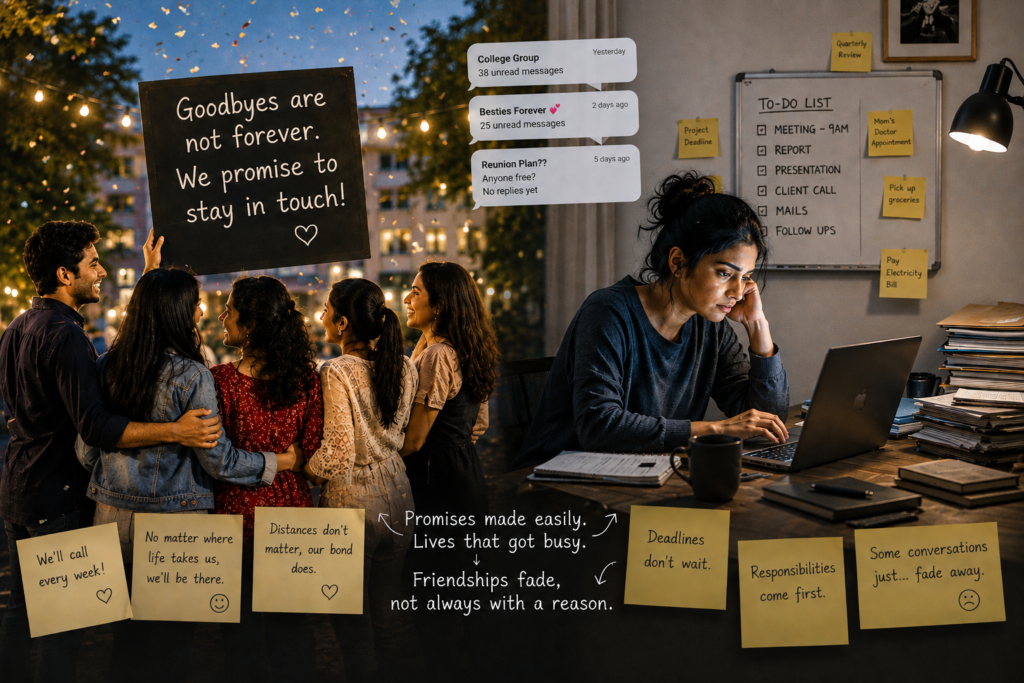
The last week of college always feels heavy and so full of love. Everyone is promising to stay in touch, meaning it fully in the moment. And for a while it works, mostly because habit is stronger. Then the jobs start, and the cities split apart. Suddenly the people who once knew your exact timetable are three time zones and a hundred unread messages away.
You just notice it, eventually, usually when you try to plan something and realise everyone’s calendar looks like a puzzle now. Friendship after college feels like something you have to choose to build, even on days when it feels like you are the one who always initiates.
Loneliness that hides inside a full life
Here’s the strange thing. You can have a very tight calendar, a family group chat that pings all day, coworkers who greet you every day. And still feel completely alone by the time you hit the bed at night.
Adult loneliness rarely looks the way people expect. It’s not an empty room. It’s a full one where nobody happens to know you particularly well. That’s an emotional loneliness that comes from feeling disconnected from friends who are still, technically, right there.
Why friendships change with age
Friendship in your twenties is usually based on how often you see each other. Friendship in your thirties runs on something else entirely, something closer to trust that survives a gap. A phone call after four months of silence that somehow still feels like no time passed at all. That’s not the friendship dying. That’s the friendship growing up alongside you.
Not every friendship makes that shift, to be fair. Some genuinely do fade, and there isn’t always a lesson buried in why.
Why don’t I have close friends anymore
Some friendships end with a fight you could point to. Most don’t. Most just slowly stop getting your attention. Not because you chose someone else over them, but because once we become adults and have our own chunk of responsibilities, our priorities change. One day you realize you haven’t spoken in months. That’s usually the real story behind why friendships fade. There’s rarely a single reason, just a slow redirection of attention until growing apart from friends becomes the quiet default.
You didn’t do anything wrong. Neither did they, probably. You just grew into two separate lives that don’t overlap anymore.
Where this leaves you

None of this adds up to a lesson or a takeaway. Some of your closest friendships from here might come from a coworker you didn’t expect much from. Some might come from a call you finally make after putting it off for a year. Some might just never happen at all.
What feels worth saying is if you feel this specific kind of loneliness, it doesn’t mean you’re flawed or missing something. It means you’re awake to where you are in life, paying attention to what’s real, even if others are too distracted to talk about it. That awareness is proof you’re still open to connection, even if it hasn’t found you yet.
